Not Every Email Should Sell: How to Build an Effective Email Content Strategy
If your email marketing content strategy relies too heavily on selling, performance will likely decline over time.
Falling engagement, rising unsubscribes, and increasing discount dependency are all signs of the same issue: your email content strategy is out of balance.
This blog explains why that happens, what most teams get wrong, and how to structure a more effective email content strategy using the right mix of email marketing campaigns.

The Problem: Everything Becomes a Sales Message
Most email strategies default to promotion.
Every send is built around an offer, a product, or a revenue moment. It feels commercially sensible. Email drives revenue, so more selling should mean more return.
But over time, the pattern becomes predictable:
Audiences expect discounts
Engagement weakens
Unsubscribes increase
Revenue becomes less efficient
The issue isn’t email itself. It’s how the channel is being used.
The Reality: Email Performance Declines When Content Lacks Balance
Email is not a series of isolated campaigns. It’s a system.
When that system is heavily weighted towards selling, the audience stops seeing value. And when value drops, so does performance.
Whilst opens can no longer be used as a primary measure of engagement, the underlying issue is still visible in more reliable signals:
Click behaviour
Conversion rate
Complaint rate
Unsubscribe rate
Revenue per send
List retention
These metrics point to the same conclusion: audiences respond better to email programmes that feel relevant, varied, and purposeful.
The challenge isn’t recognising the problem. It’s knowing how to structure that balance in a practical way.
A Practical Framework for Balance: The Content Compass
Most teams know they shouldn’t only send sales emails. Fewer know what to replace them with.
This is where the Content Compass becomes useful. It’s a simple framework for structuring your email content across four distinct roles:
Educate (help customers understand value)
Engage (keep your audience interested)
Support (improve the customer experience)
Sell (drive commercial action)
The goal isn’t to remove sales emails. It’s to stop over-relying on them.
When one area dominates (typically Sell), the entire programme becomes less effective. When all four are working together, performance becomes more stable and scalable.
Using the Content Compass to Structure Your Email Strategy
1. Educate: Help Customers Understand Value
Educational emails focus on clarity, not conversion.
They explain how products work, where they fit, and why they matter. This reduces friction and builds confidence before a purchase decision.
What this looks like:
Product use cases
“How it works” content
Comparisons or explainers
Commercial implication:
Better understanding leads to stronger, more consistent conversion without relying on discounts.

This email from Claude supports Educate by clearly explaining new capabilities and use cases, helping the reader understand the product’s value in a practical way.
2. Engage: Maintain Attention Between Campaigns
Engagement emails give subscribers a reason to stay connected—even when they’re not ready to buy.
They build familiarity and keep your brand relevant without asking for immediate action.
What this looks like:
Editorial-style newsletters
Insight-led content
Brand storytelling
Commercial implication:
Stronger ongoing engagement improves campaign performance when you do sell and supports long-term deliverability.
This email supports Support by guiding the customer based on their situation, reducing friction and helping them take the right next step.

This email from Who Gives a Crap supports Engage by using personality and storytelling to build connection, giving the reader a reason to stay interested without pushing a sale.
3. Support: Improve Post-Purchase Experience
Support content is often underutilised, but it plays a critical role in retention.
It helps customers get value after they’ve already converted.
What this looks like:
- Onboarding emails
- Product guidance
- Reorder reminders
Commercial implication:
Improved customer experience increases repeat purchase rate and lifetime value.
4. Sell: Use It Strategically, Not Constantly
Sales emails are still essential. But their effectiveness depends on timing, relevance, and clarity.
When every email is a sales email, none of them stand out.
What this looks like:
- Campaign launches
- Product drops
- Time-sensitive offers
Commercial implication:
A more selective approach to selling improves efficiency and reduces reliance on heavy discounting.

This email from Apple supports Educate by clearly explaining product features and value, helping the customer understand why the product matters before making a purchase.
Example: Rebalancing a Typical Email Programme
Many brands operate like this:
Frequent promotional sends
Limited lifecycle or support content
Inconsistent engagement messaging
Viewed through the Content Compass, this is heavily weighted towards “Sell” with little coverage elsewhere.
To review your overall programme, apply the Content Compass across a range of recent campaigns and map each one against the four roles.
When you aggregate those scores, you get a clear picture of how your email strategy is weighted and where gaps or over-reliance exist.
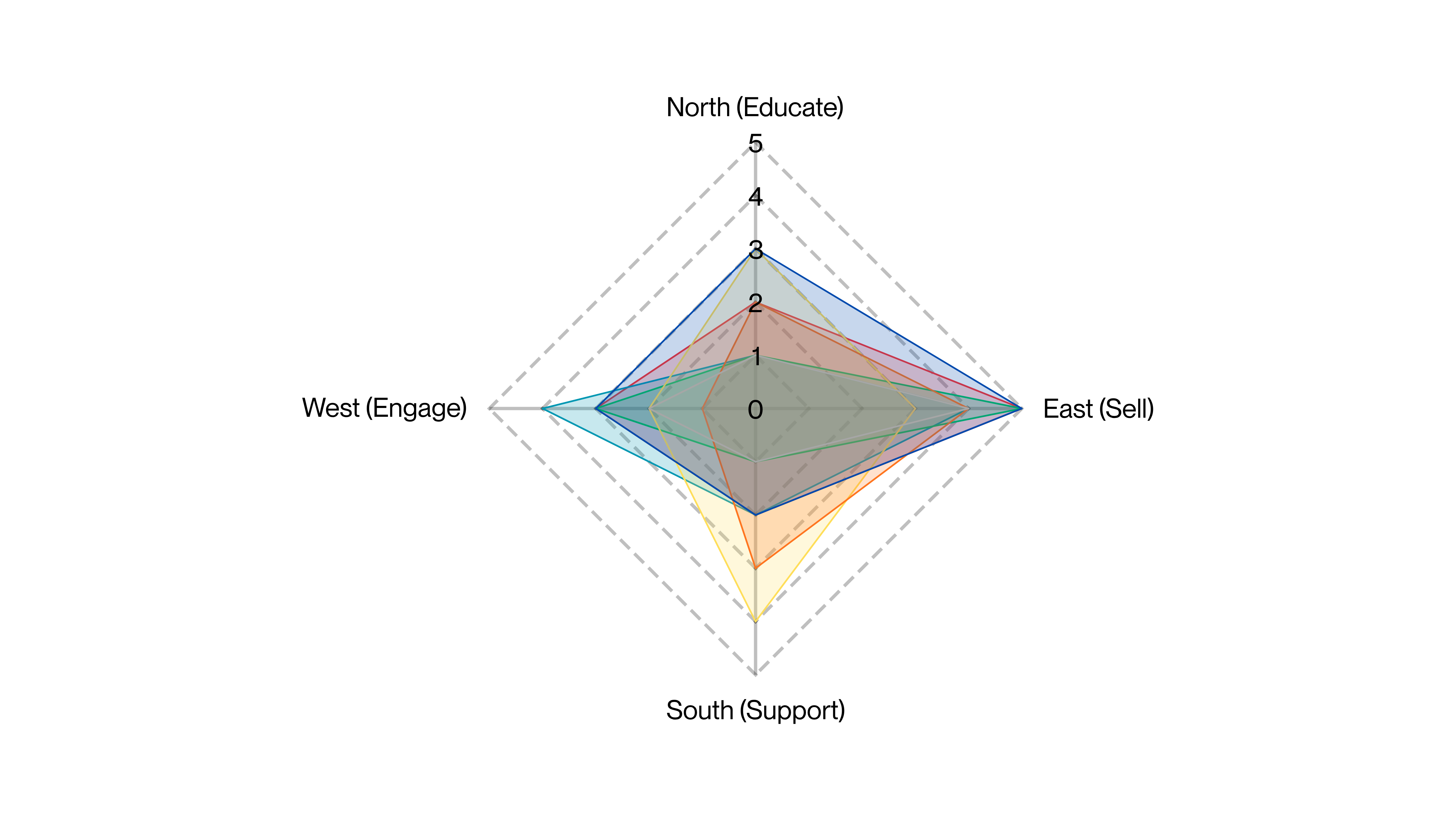
Above: An example of using the Content Compass (i.e. a radar chart) to add multiple emails and highlight where you may be over indexting on the "Sell" message.
A more effective structure looks like:
Fewer, higher-quality sales campaigns
Regular educational content
Consistent engagement emails
Always-on support journeys
Same audience. Same channel. Better results.
Implication: Clear Roles Drive Better Performance
When each email has a defined role within the Content Compass, performance improves across the board:
Higher click engagement
Stronger conversion rates
Lower unsubscribe rates
More stable revenue
The improvement doesn’t come from sending more.
It comes from sending with intent—and balance.
You Don’t Have a Copy Problem. You Have a Content Problem.
When performance drops, many teams focus on optimising subject lines or redesigning templates.
But if your Content Compass is unbalanced, those changes have limited impact.
This is a structural issue, not a surface-level optimisation problem.
The Content Compass provides a practical way to diagnose gaps, rebalance your programme, and build a more effective email content strategy over time.
Parting Thoughts
Not every email should sell.
But every email should have a role.
The brands that balancing Educate, Engage, Support, and Sell consistently are the ones that sustain engagement, reduce dependency on discounts, and drive more consistent long-term revenue.
Subscribe to our insights newsletter
Be the first to know what's trending in email and CRM.
Share this story
Related insights


Article 5 min read
Lifecycle Marketing Strategy: Start With the Customer Action, Not the Channel
Read post
Article 5 min read