How to avoid email fatigue during peak season
Your campaign calendar might look manageable. A sale launch on Tuesday, product picks on Thursday and a reminder before the offer ends.
But a customer could also be receiving welcome emails, basket reminders and a birthday promotion. Each message has a reason to exist. Together, they can become a week of competing requests for attention.
Avoiding email fatigue during peak starts with understanding that combined experience. You need to know what each customer is receiving, which messages matter now and what should stop when their behaviour changes.
The aim is to make every send earn its place while balancing peak revenue with the opportunity to reach that customer again.
October 29 - 2026
Jay Wicks

Your campaign calendar is only part of the picture
Digital fatigue is the pressure people feel from the wider stream of emails, notifications, advertising and content. Customer fatigue is more specific: people begin tuning out a brand because its communications feel too frequent, repetitive or irrelevant.
A customer who stops clicking has not necessarily lost interest in the brand. They may have already bought, have no need for the current offer or simply have other priorities. Reduced response is a reason to investigate, rather than a diagnosis of fatigue.
Your team controls the pressure your brand adds. Three questions help guide that responsibility: who receives what, how often and when should contact pause?
Consider an illustrative week for someone who purchases and opts into marketing on Monday, then abandons a new basket on Wednesday. Before contact controls are applied, they could qualify for:
Five campaigns covering the sale launch, a category, top picks, the closing deadline and a local event.
Three welcome emails.
Two basket reminders.
One birthday promotion.
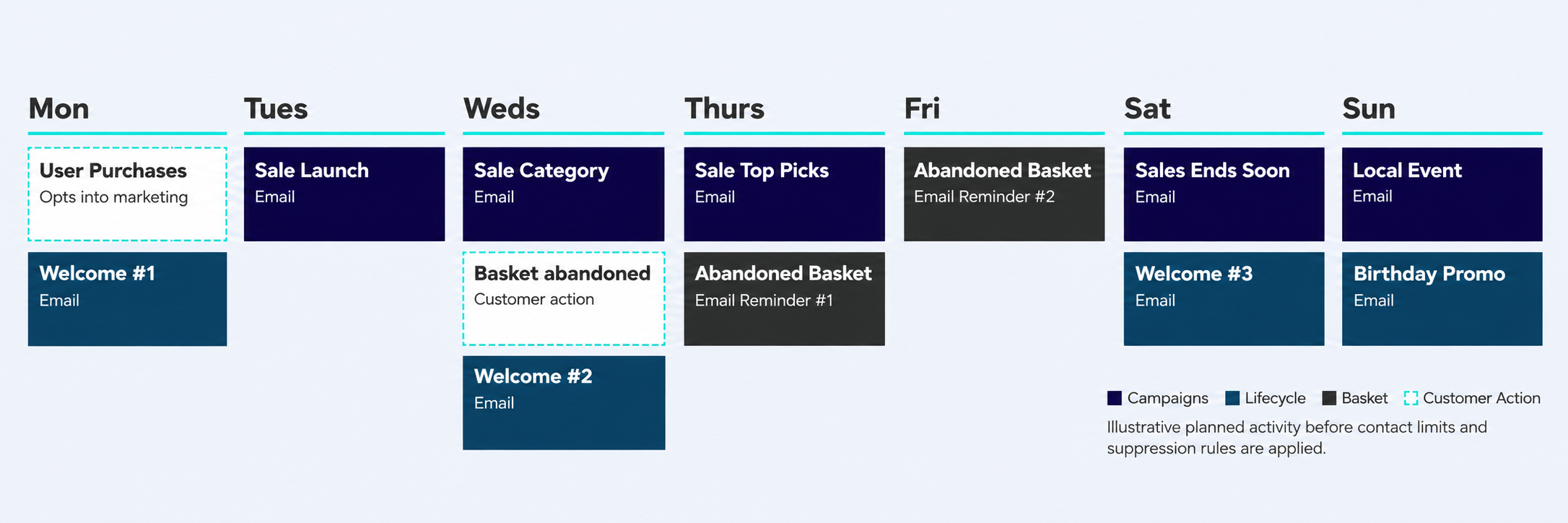
That is 11 potential emails in seven days for one customer.
This is a planning example, not evidence that a customer received all 11 or experienced fatigue. It shows why reviewing campaigns and automations separately can miss the problem.
The useful question is what the combined programme asks this person to do, and whether those requests still make sense.
Look for patterns before changing frequency
A crowded week gives you something to investigate. It does not tell you what to remove.
Start with emails actually sent alongside those planned. Check when campaigns and journeys overlap, then add the customer's clicks, basket activity and purchases to the same timeline.
A purchase may make a promotion unnecessary. A new basket may create a reason for a different follow-up. Repeated sends without a response may suggest that extra peak activity needs to pause.
Then compare patterns across similar customers over the same period. Are people receiving more messages also unsubscribing more often? Does the pattern differ between recent purchasers and active shoppers? Are particular overlaps associated with weaker response?
These comparisons help identify what to test. They do not establish that email frequency caused the outcome. Customers who receive more emails may also be more active, qualify for more journeys or have different buying habits.
Make the next decision using current behaviour
Customer groups help organise treatment, but the rules need to respond when circumstances change.
A recent purchaser might be paused from general promotions for 72 hours, with other messages reviewed individually. Someone who clicked or created a basket within the past 30 days might qualify for a relevant follow-up. A customer who received at least three emails in 90 days without a click, basket event or purchase might be excluded from extra peak sends. Investigate the lack of response before deciding whether a deliberate re-engagement approach would help; adding more reminders is not automatically the answer.
Those are illustrative starting points. Set the windows around your buying cycle, sending history and customer expectations.
The important detail is how the rules interact.
Someone who buys on Monday can create a new basket on Wednesday. The recent purchase still matters, but so does the new intent. Your rules need to recognise both, allowing an appropriate basket reminder to be considered while keeping unnecessary promotions paused.
Check that the basket remains abandoned before each reminder. Once the customer buys, the reason for that reminder has gone.
Agree which message takes priority
Imagine that Thursday's sale top-picks campaign competes with the first reminder about Wednesday's basket.
The campaign encourages more browsing. The reminder relates to products the customer has already selected. In this example, assuming the basket remains unpurchased, the reminder has the stronger claim on their attention.
That is a decision about this customer at this moment. It does not establish that basket reminders should always win or that general promotions are less valuable. Depending on eligibility and contact pressure, one or both messages may still need to be suppressed.
That decision should be deliberate and shared across the programme. A general promotion should not take the available contact slot simply because it was scheduled first.
Equally, an automated message should earn its priority through relevance. Being triggered does not give it an unlimited right to send.
Apply shared checks before sending
Use three checks across marketing campaigns and journeys:
Eligibility: Is marketing permission in place, and does this customer still qualify for this message?
Priority: Is this the most useful message for them right now?
Contact pressure: Does it fit within the shared contact limit?
If a message fails eligibility or loses priority, suppress it. If the contact limit blocks an otherwise relevant message, consider whether it will still be useful later. Delay where appropriate, then repeat all three checks before sending. A delayed message should not sit in a queue indefinitely or bypass the rules later. Suppress it if its purpose will have expired.
Apply these controls to marketing sends. Keep necessary service messages, such as order confirmations, outside promotional suppression.
Agree who owns the shared rules so campaign and automation owners work to the same decisions. Coordination helps the programme work together and gives teams a consistent basis for deciding what should send.
Carry the promotion where it already fits
Some promotional content can sit within a relevant journey email.
For example, a basket reminder might include a sale banner where the offer applies to those products. A welcome email could carry current promotional content if it supports the message's purpose.
That can remove the need for a separate campaign, but test whether the extra content helps. A sale banner might support a basket purchase or distract someone into browsing again. Helping someone complete their existing basket should remain the focus of the reminder.
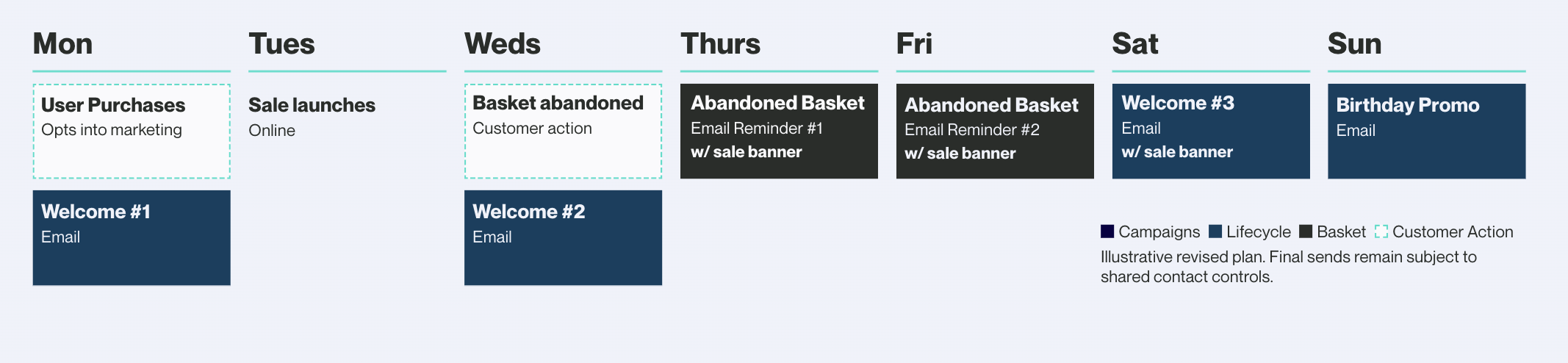
In our illustrative week (above), removing five standalone campaigns leaves six proposed journey and birthday emails, with selected journeys carrying relevant promotional content. That is around 45% fewer potential sends.
Six is still a proposal. Every remaining message must pass the shared checks, and customer actions may change what is eventually sent.
Fewer emails is a change. Test whether it is a result.
A reduction in sends does not establish a better customer experience or stronger commercial performance. Sending fewer emails could sacrifice some immediate revenue. The question is whether the revised approach creates more value from the customer relationship over time.
An unsubscribe removes the opportunity to reach that person through the current email subscription. They may still buy through another route, but email can no longer play the same role in encouraging their next purchase.
What retained subscribers could mean
Consider a hypothetical group of 1,000 customers. If each remaining subscriber receives all 11 emails and 0.4% unsubscribe after each send, around 957 would remain subscribed at the end. With six emails and an assumed unsubscribe rate of 0.2% per send, around 988 would remain: 31 additional subscribers per 1,000 customers.
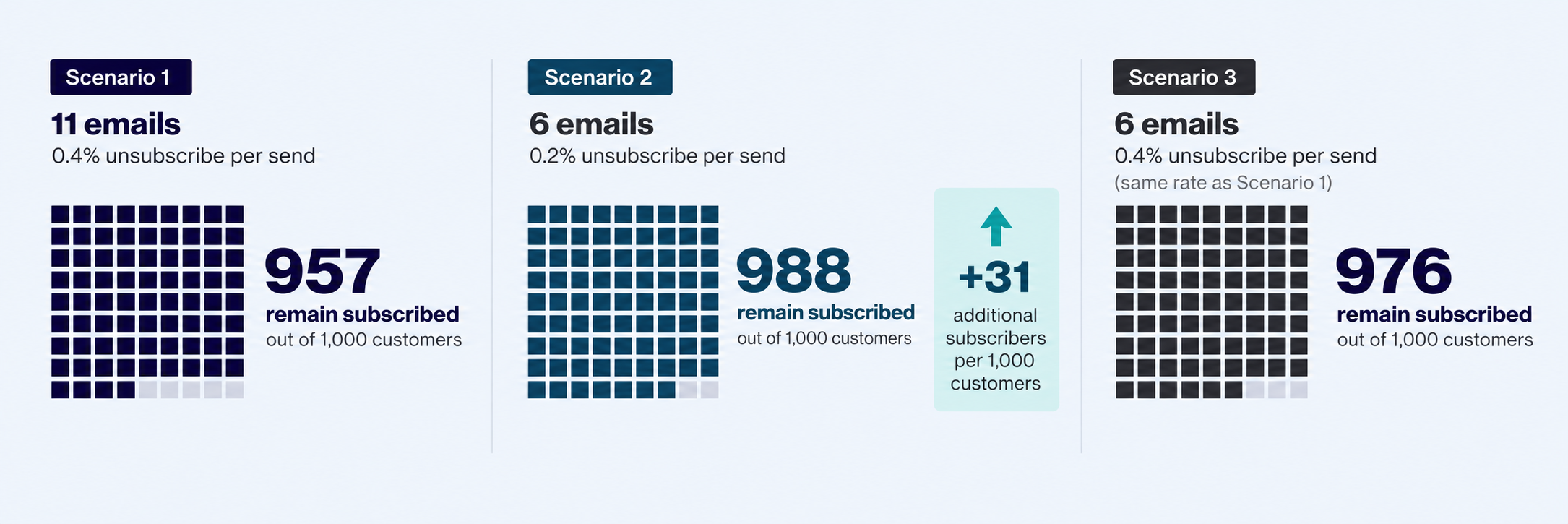
These are modelled outcomes, not observed results. The calculation removes unsubscribers from subsequent sends, and the lower unsubscribe rate in the revised approach is an assumption to test. Cutting sends does not establish that the rate per email will halve.
To separate those effects, keeping the unsubscribe rate at 0.4% across six sends would leave around 976 subscribed. Fewer sends reduce the number of opportunities to unsubscribe in this model; better relevance could provide a further benefit, but that still needs evidence.
Remaining subscribed also does not establish greater customer lifetime value. Those customers need to go on to engage and purchase for the retained opportunity to translate into commercial value.
Measure the commercial outcome
Compare the existing approach with the coordinated approach using a random split of the same eligible customer population. Assign customers before the different sending rules take effect, and keep them in their assigned groups throughout the test.
Measure short-term revenue per eligible customer, actual emails sent and unsubscribes. Then follow subscriber retention, repeat purchase and cumulative revenue per customer over an agreed period.
Use the eligible population as the basis for the commercial comparison. Looking only at people who received an email would exclude customers deliberately suppressed by the revised approach.
Read unsubscribe rates alongside the number of customers lost and the proportion who remain subscribed. Different send volumes can make a single rate an incomplete picture.
The revised approach needs to justify itself against the commercial outcome you agreed to test. A quieter inbox alone does not settle that question.
Start with one customer group
Choose a group receiving both campaigns and automated marketing emails. Map a week of planned and actual contact alongside what those customers did. You may find that the existing rules are working well. Where they are not, focus on specific overlaps or messages whose purpose has expired; a complete programme overhaul is not the starting requirement.
Agree which overlaps to change, which messages deserve priority and when contact should pause. Put the shared rules in place, then test the combined experience.
Revenue from today's email matters. So does retaining the opportunity to reach that customer tomorrow.
Before adding the next peak send, be clear about what makes it worth receiving.
If your campaigns and automated journeys are competing for the same customers, it might be time to rethink how you manage them. At Jarrang, we help brands bring structure to their email marketing, from smarter targeting to clearer rules around what gets sent and when. If that sounds like a challenge you're facing, get in touch. We'd love to hear what you're working through.
Subscribe to our insights newsletter
Be the first to know what's trending in email and CRM.
Share this story
Related insights

Article 7 min read
Black Friday email marketing strategy: 8 CRM priorities for peak
Read post
Article 5 min read
