How to Drive Incremental Revenue with CRM
Marketing teams are under constant pressure to generate more revenue, increase customer engagement and demonstrate the commercial value of their activity.
But how do you deliver additional growth when your CRM programme is already running, your campaigns are planned and your customers are receiving regular communications?
The answer isn't necessarily to send more emails, build more automations or increase promotional spend. It's to identify where smarter marketing could influence customer behaviour, and create value that wouldn't otherwise exist.
That's what incrementality is about.
For marketing directors, heads of communications and CRM teams, the opportunity is significant. Existing campaigns and customer journeys provide countless opportunities to improve targeting, timing, relevance and the wider customer experience.
The harder part is knowing which improvements genuinely generate additional revenue or engagement, rather than simply taking credit for results that would have happened anyway.
And that's where many teams face a practical challenge. Testing happens occasionally, often as a standalone project, rather than being built into everyday marketing activity.
At Jarrang, we've developed the PROVE Framework to address this. A five-stage approach designed to help teams identify incremental opportunities, measure their contribution and build continuous improvement into business-as-usual CRM.
Here's how it works.

What is incremental revenue, and why does it matter?
Incremental revenue is the additional revenue generated by marketing activity beyond what would have happened without it.
In simple terms, it's the revenue you wouldn't have achieved otherwise.
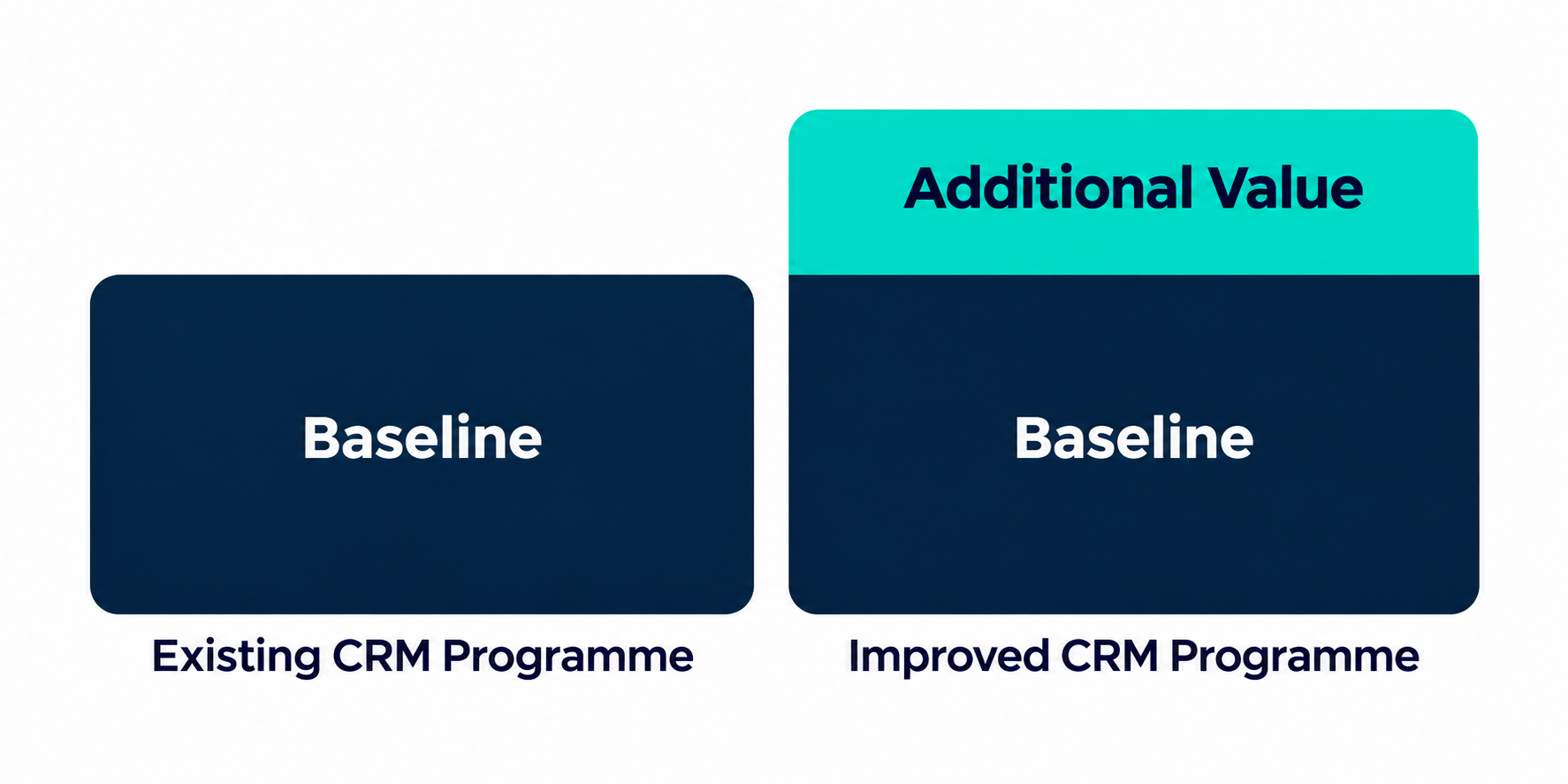
The same principle applies to incremental engagement. This could mean additional website visits, product exploration, repeat interactions or other meaningful customer behaviours that wouldn't otherwise have occurred.
A purchase after an email isn't necessarily a purchase because of it.
Some customers are already planning to purchase. Others might have returned to your website or engaged with your brand regardless of the message they received.
For businesses investing in CRM, understanding this difference changes how marketing performance is evaluated.
Rather than simply asking how much revenue a campaign generated, we can begin asking how much additional value our activity actually created.
That provides a stronger basis for deciding where to invest time, budget and resources.
Incremental revenue versus attributed revenue
Attribution remains a valuable part of marketing measurement.
It tells us which campaigns, channels or customer interactions receive credit for a conversion, according to the rules being used.
Incrementality asks something different.
Would that conversion have happened without our marketing activity?
An email might receive credit for a £200 purchase. But if the customer was already preparing to buy, the email may have contributed little or no additional revenue.
Equally, an email that generates relatively modest attributed revenue might create genuine value by encouraging customers who wouldn't otherwise have purchased.
Neither outcome can be established through attribution alone.
This doesn't make traditional CRM reporting redundant. It means attribution and incrementality should work together, helping teams understand both what happened and what their marketing actually changed.
Our guide to measuring email marketing effectiveness explores the wider performance metrics available to marketers.
Where can CRM teams find incremental growth?
For established CRM programmes, some of the most useful opportunities may already exist within current activity.
Rather than starting with another campaign, teams should examine where changes to an existing customer experience might generate more value.
Four areas provide a useful starting point.
1. Audience: Reach customers who could respond differently
Many CRM campaigns still rely on broad targeting, despite businesses holding valuable information about customer interests, purchasing behaviour and lifecycle stages.
Could using that information more intelligently generate additional conversions from audiences that currently receive less relevant content?
The opportunity isn't simply to create more segments. It's to identify where a different targeting decision might change the outcome.
2. Timing: Reach customers when it matters
Automated journeys often rely on fixed delays or standard schedules.
But purchasing behaviour, customer intent and engagement patterns vary.
Could changing when a message arrives generate additional purchases or meaningful engagement?
The important point is to measure whether timing creates more value overall, rather than simply bringing forward behaviour that would have happened later.
3. Messaging: Improve relevance without relying on discounts
Not every customer needs an incentive to purchase.
Someone already close to conversion might respond to product reassurance, additional information or a more relevant recommendation.
Could a different message increase conversion or protect margin without offering unnecessary discounts?
That creates an opportunity to test both additional revenue and the quality of that revenue.
4. Prioritisation: Make existing communications work harder
As CRM programmes grow, customers can qualify for several campaigns and automated journeys within a short period.
Rather than simply sending everything, could choosing the most relevant communication generate a better commercial outcome?
This is particularly relevant when businesses want to improve performance without increasing overall email volume.
These opportunities all have something in common.
They sound sensible, but we don't yet know whether they'll generate incremental value.
That's why a better CRM strategy needs more than good ideas. It needs a repeatable way to test them.
Why incrementality testing needs to become part of BAU
For many marketing teams, testing is nothing new.
Subject lines are compared, creative variations are evaluated and automated journeys are regularly adjusted.
But there's an important difference between identifying which variation performs better and establishing whether that improvement creates meaningful additional business value.
A higher click-through rate might be encouraging, but did it lead to more purchases?
A journey might generate more immediate conversions, but did customers spend more over time?
A discount might increase sales, but was the additional revenue worth the reduction in margin?
These questions require a more deliberate approach to measurement.
The challenge for marketing leaders is making that approach practical.
Incrementality testing shouldn't depend on occasional analysis projects or require teams to reinvent the measurement process every time they want to improve something.
Instead, it should become a normal part of CRM planning, optimisation and performance reviews.
That means agreeing what an improvement is intended to achieve, establishing a fair comparison, measuring the result and using what we've learned to inform future activity.
The objective isn't to turn every email into an experiment.
It's to create a consistent process for identifying the improvements worth testing and understanding their contribution.
Introducing the Jarrang PROVE Framework
The Jarrang PROVE Framework provides five connected stages for identifying, testing and embedding incremental CRM improvements.
The framework is designed to work with existing marketing activity, helping teams move from assumptions about potential value towards evidence they can use to make decisions.
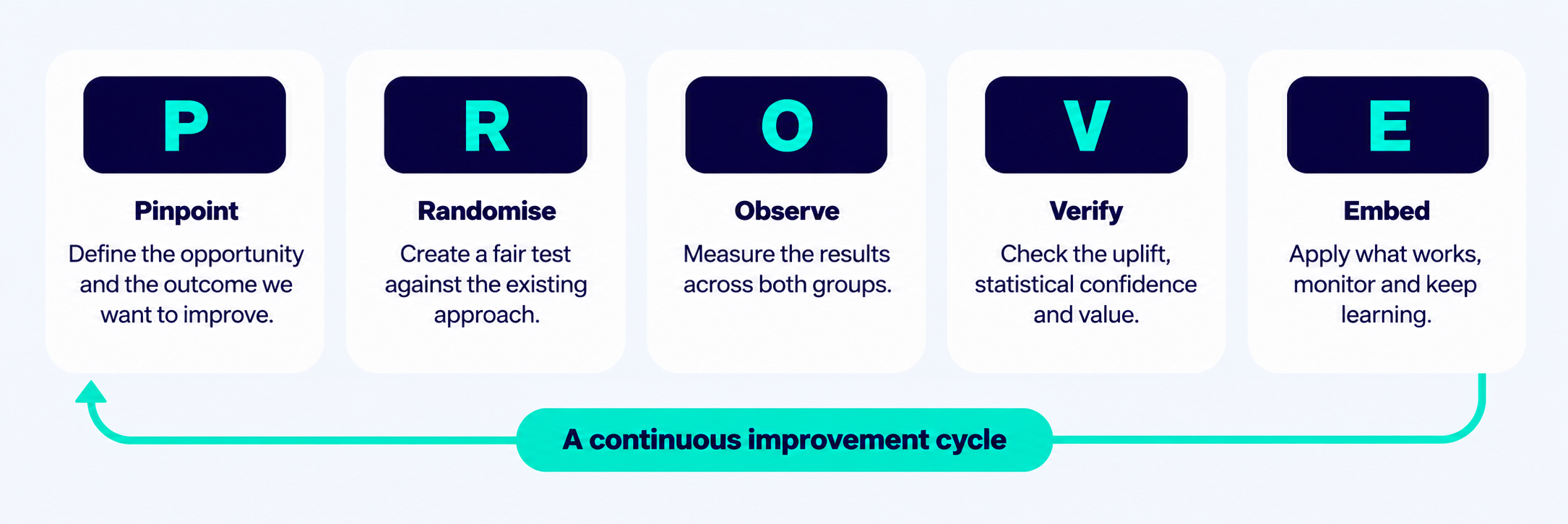
P: Pinpoint the opportunity
Start by identifying what you believe could work better.
It might be audience selection, journey timing, messaging or how different communications are prioritised.
Define the specific change you want to test and the outcome you're trying to improve.
For example, could more relevant messaging increase repeat purchases among existing customers?
The important thing is to establish what success would look like before making the change.
R: Randomise the audience
To understand whether an improvement genuinely adds value, we need a fair comparison.
Where possible, randomly divide eligible customers into two groups.
One experiences the existing CRM approach, while the other experiences the proposed improvement.
This allows us to compare outcomes without relying solely on attributed conversions.
Randomisation helps reduce the risk that differences between customers, rather than the marketing change itself, explain the result.
Where randomisation isn't practical, alternative comparison methods may be appropriate, but their limitations need to be understood.
O: Observe the results
Measure what happens across both groups over the same agreed period.
The outcomes should reflect the original objective.
If we're trying to increase revenue, we might examine purchases or revenue per eligible customer.
If we're trying to improve engagement, we might measure additional website visits, product interactions or sustained customer activity.
The goal is to understand the difference between the existing approach and the proposed improvement, rather than looking at the new activity in isolation.
V: Verify the improvement
This stage acts as the decision point before an improvement is introduced more widely.
First, is the observed difference statistically credible?
A positive uplift is encouraging, but some variation happens naturally between groups. Statistical testing helps establish whether the evidence supports a genuine improvement.
Then comes the commercial question.
Does the additional revenue or engagement justify the costs, effort and any wider consequences of the change?
A statistically significant uplift isn't automatically a commercially worthwhile one.
Both questions matter before deciding what to implement.
E: Embed the learning
This is what makes PROVE a continuous improvement framework rather than a one-off testing method.
Once an improvement has sufficient evidence behind it, it can be introduced into everyday CRM activity and monitored over time.
But the process shouldn't end there.
Record what worked, what didn't and what remains uncertain.
Those findings can then inform the next opportunity, creating a continuous cycle of testing, learning and improvement.
Even an unsuccessful experiment has value if it helps the team make a better decision next time.
Pinpoint. Randomise. Observe. Verify. Embed. Then repeat.
How PROVE demonstrates incremental value
Consider a hypothetical business testing improvements to an existing abandoned basket journey.
The CRM team believes that better timing and more relevant messaging could increase conversions.
Using PROVE, they identify the opportunity and randomly divide 10,000 eligible customers into two equal groups.
The control group receives the existing journey. The test group receives the improved version.
After seven days, the results are:
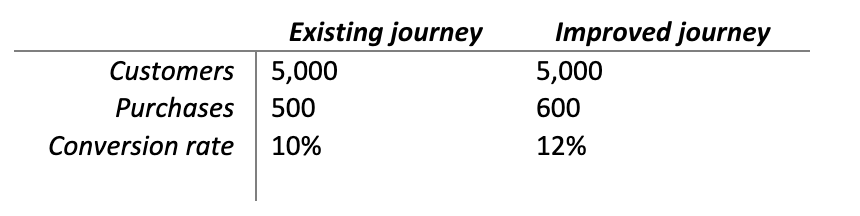
The improved journey achieved a 12% conversion rate compared with 10% for the existing approach.
That's a two-percentage point improvement, or a 20% relative uplift.
Based on the control group's performance, we estimate that the improved journey generated 100 additional purchases.
Assuming an average order value of £80, that represents approximately £8,000 in incremental revenue.
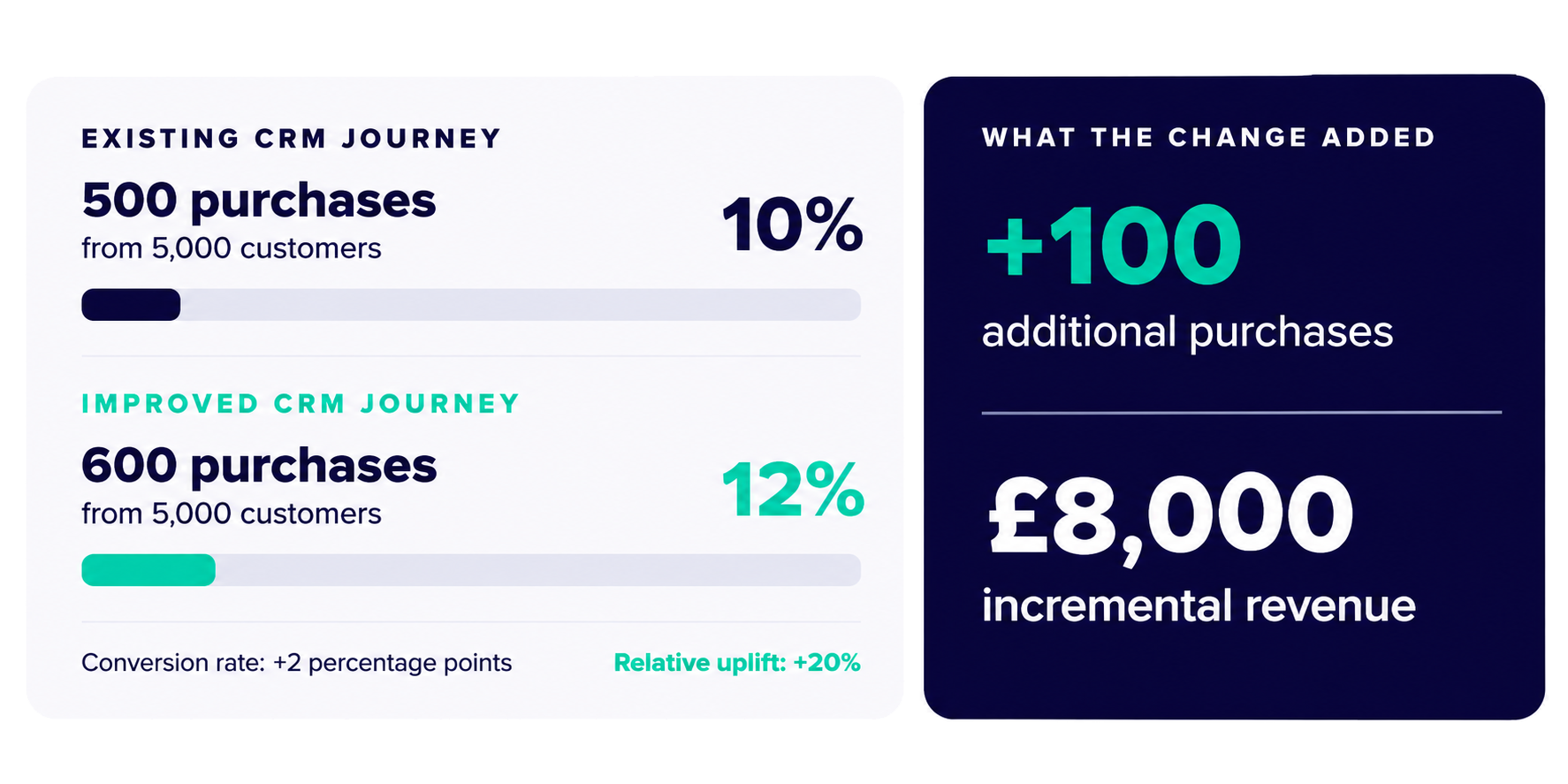
The important distinction is that the improved journey generated £48,000 in total revenue, but its estimated additional contribution was £8,000.
Those aren't interchangeable measures.
This is an illustrative experiment, not an observed client result. The revenue estimate assumes the same £80 average order value in both groups.
Why statistical significance matters
Before introducing this improvement more widely, we'd need to check how reliable the result is.
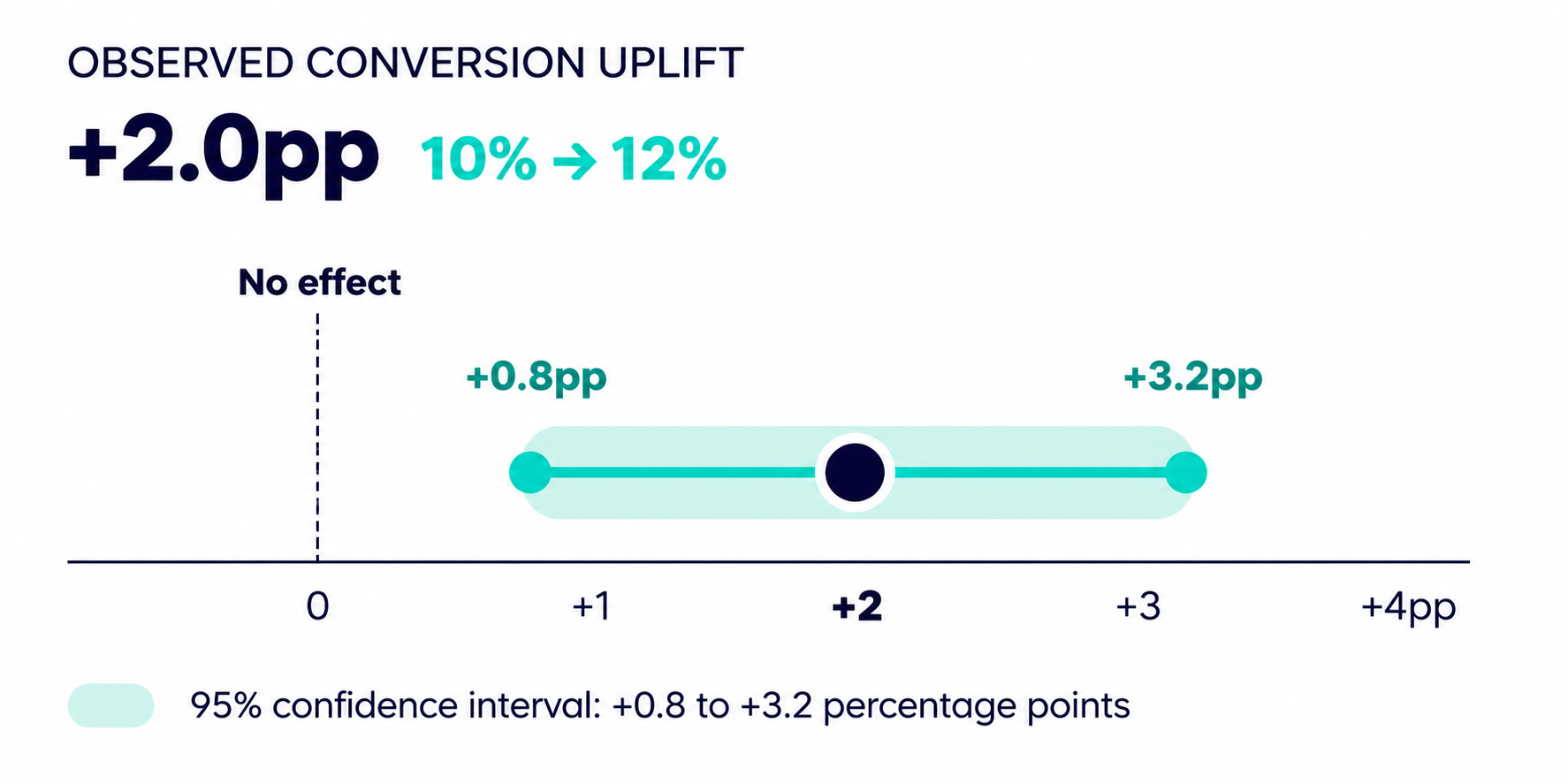
We want to know whether the extra purchases are likely to be a genuine improvement or whether the difference could simply be down to chance.
In our example, the results pass a commonly used statistical check. That gives us good reason to believe the improved journey performed better than the original.
But more sales don't necessarily mean more profit. We'd still need to consider what the additional sales were worth, what the change cost and whether the improvement is likely to last.
For a real revenue experiment, we'd also examine actual spending across both groups rather than relying on an assumed order value.
This is the purpose of Verify: to give the business a sound basis for deciding whether an improvement should be adopted.
How to make PROVE part of everyday CRM activity
The long-term benefit of PROVE comes from using it consistently, rather than treating incrementality as a special measurement project.
That doesn't mean every campaign needs its own control group or statistical analysis.
It means building testing and learning into the places where CRM decisions are already made.
Start with an opportunity backlog
Review existing campaigns, journeys and customer experiences to identify potential improvements.
Prioritise opportunities based on their likely commercial value, the ability to measure their impact and the effort required to test them.
This gives the team a practical starting point rather than an endless list of optimisation ideas.
Agree the measurement before launching
Define the customer group, proposed change, primary measure of success and test period before implementation.
Check whether the available audience is large enough to support a useful experiment.
Where the evidence is likely to be too limited, reconsider the test design rather than treating an inconclusive result as proof of success or failure.
Make testing part of existing planning and reviews
Incrementality doesn't need a separate programme running alongside everyday CRM delivery.
Testing opportunities can be discussed during campaign planning, journey reviews and regular performance meetings.
The important thing is that someone owns the test, its measurement and the decision that follows.
Keep a record of what the team learns
Successful tests should inform future CRM activity.
Unsuccessful or inconclusive tests should be recorded too.
Over time, that record helps teams avoid repeating unsuccessful approaches, identify patterns and make more informed decisions about future improvements.
It also makes learning less dependent on the individuals who originally designed or delivered each experiment.
Our article on building a repeatable lifecycle CRM system explores why shared operating rules and continuous learning matter as CRM programmes grow.
From incremental opportunities to continuous growth
Most established CRM programmes already contain opportunities to generate more value.
They may exist within customer targeting, message relevance, journey timing or the decisions that determine which communications customers receive.
Finding those opportunities is only the beginning.
The real challenge is knowing which improvements genuinely influence customer behaviour, which are commercially worthwhile and how to make the learning part of everyday marketing activity.
For marketing leaders, that's where incrementality becomes more than a measurement exercise.
It becomes a practical way to direct investment, improve existing activity and demonstrate the additional value CRM creates.
You don't need to rebuild your programme to start.
Choose one existing campaign or journey. Identify one change worth testing. Agree what success looks like and use PROVE to establish whether that change creates additional value.
Then take what you've learned, improve the programme and repeat.
The goal isn't simply to report more revenue. It's to create more revenue and engagement than you would have achieved otherwise, prove it and keep building on that progress.
Want to find out where your CRM could be doing more? Get in touch with Jarrang and let's explore where you could create more value.
Subscribe to our insights newsletter
Be the first to know what's trending in email and CRM.
Share this story
Related insights


Article 7 min read
Black Friday email marketing strategy: 8 CRM priorities for peak
Read post
Article 5 min read